
This took way, way too long. I started playing through Final Fantasy VI Pixel Remaster shortly after finishing Final Fantasy V Pixel Remaster, and I hit a point where I sort of burned out and put it down. Picked it up again last year, put it down again and picked it up again a few months later. Finished at the end of August.
I already had some notes, but I didn’t feel right about finishing off a review unless I’d finished the game. Sometimes it’s okay to do so, but I don’t feel that it’s a good idea to cover something unless you’ve gone through it all.
So I finished the game, wrote a lengthy and rambling rough draft, and very slowly chipped away at it to turn it into something readable. But it was slow progress, with a lot of gaps between looking at what I’d written.
During this break I’ve had I sat down and finally dug away, and got to a point where I felt I was done. Decided to publish it the following day as it was a lot of hours sunk in and I wanted to rest. Then I sat on it, thought about it and realised there was a little more I wanted to add.
Then I spent most of the last thirteen, fourteen hours doing more editing. It was, overall, a slog, and I’m glad it’s done.
Most of my interview and review work now appears on Culture Eater.
My colleague and I set up a Patreon to further develop Culture Eater as a source of good quality arts coverage from both ourselves and our contributors.
We’re looking at what we can give to supporters as we don’t want to set up a one way relationship, so suggestions are welcome. Podcast Eater is one of the things we’ve got going and (aside from the next few weeks) new episodes are available through there first.
Please consider supporting, or at least sharing the Patreon page with others. Please also check out what our wonderful contributors are contributing.
I hope you enjoy.
—
Of the first six games of the Final Fantasy series, Final Fantasy VI is the third. And the sixth. Pixel Remaster series goooooo! And now (or rather, almost three years ago) VI got its remaster treatment as part of the Pixel Remaster Final Fantasy Higgledy-Piggledy and so on and so forth.
The plot is thus: Malfeasance! The heinous power of the greed of man rises and engulfs all. The encroaching reach of an empire unchecked strikes at those that would dare resist. In this growing damnation, the rediscovery of power better left forgotten becomes a portent for what is yet to come. However, a chance meeting between a mysterious mech pilot and a wealth reliever leads to a journey that might just turn things around.
Final Fantasy VI is something of a culmination for the Final Fantasy series up to that point, but it’s more than just another step. Its tone is noticeably darker than most of the prior mainline games, though it still has room for silly moments, and gradually-increasing optimism. The narrative, character development and aesthetic design are more detailed and complex. There’s greater breadth and depth in the music. Characters are now two characters tall.
The general loop remains somewhere near the same as what came before. Usually world map > “safe area” > dungeon. It worked before and it works now, but, partly from design of the world, it’s less apparent. The world map, whilst still guiding, is more expansive and less rigid in appearance; towns are fleshed out, and dungeons are better cemented as part of the environment.
In line with its tone, VI has a sombre and at times bleak atmosphere, though with some beautiful scenery. Being a remaster, the Pixel Remaster version still looks that way, but in places the colour palette feels more saturated. Saturation in a dark game can work, but VI‘s comparatively dulled colouring fed into its atmosphere. In the PR version it feels more in conflict as, when it’s obvious, it can come off as excessive. That said, there are places where the saturation works quite well, helping to get across a beneficial lavishness and intensity. There are also places where this version takes advantage of an expanded colour spectrum to its benefit.

Once more towns are towns. They’re more structured than in prior games, and there’s some detail variance making use of one aesthetic. They’re often their own places, but it’s clear that they belong to the same world. The impact of the main antagonistic forces is usually felt too, either by their presence or from NPC dialogue, among other factors. Essentially the towns feel like places where people live rather than just places.
Dungeons are quite linear, but they’re also varied, and that’s nice. Some have tricky bits, but generally they’re all pretty straightforward. There’s enough challenge on offer throughout them, but seldom anything frustrating, and they’re not too time-consuming. Where they stand out is how they fit in the world. A forest isn’t just a forest, but a dewy, cool forest. Mountains have winding clifftop paths connecting to internal spaces, and feel massive from how much of them you don’t see. Urban dungeons feel like extensions of the areas they’re in. You get the idea. There’s a lot of detail and care in how they look and fit, which helps them belong to the setting.
When talking about Final Fantasy VI it’s easy to talk about the protagonists as the game goes a long way to push them… to a point. You’ve a party of varied, broken people, and the game dedicates time to explore each one. They’re expressive, they’ve personality and they’ve development. However, most aren’t fighting for the spotlight. Square was ambitious in including as many playable characters as they did, and it’s nice that they have individual personality. It’s nice that they see resolution in their personal stories too. It’s easy to buy into the main cast’s various turmoils as they’re carefully considered, well-developed characters. It would’ve been better had most not fallen by the wayside once their stories resolved.
Battles are battles are battles. You fight to survive and the enemy must fall by dint of your strikes. Combat feels… not slow, but usually at the right pace. Sometimes they feel like they could be faster, but generally they move at an appropriate speed. In general a lot of the fighting is straightforward, but occasionally you have one that requires some thinking. Perhaps not enough to give it depth, but just enough to prevent total monotony.
Each character has their own ability; One character can throw items; another, absorb spells. One character can dance, and another can use various tools. Generally the abilities are useful throughout, with some easier to use in the PR version due to tweaks in how they work. However, a number of them will fall off in use as you work on improving your characters.
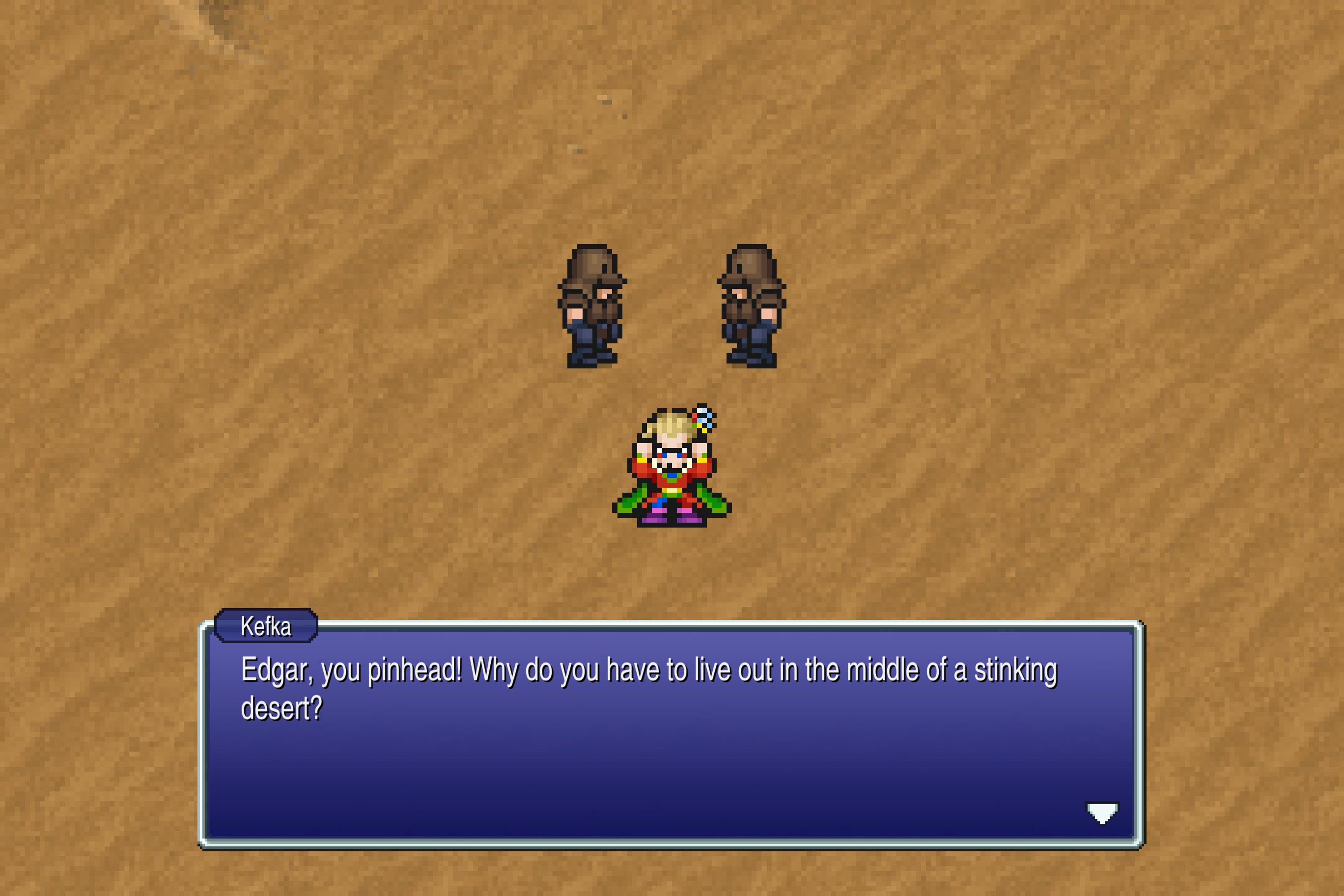
At a certain point in the game you get access to espers, which are your summons and how you learn magic. Each esper has a set of spells and different rates of learning for said spells. Each character can equip one at a time. The limit does increase the grind, but at the same time it helps reinforce thinking about how to develop who you’ll use.
Some espers also provide stat boosts upon level up. Based on initial stats, VI hints at which way to build which characters, but there’s nothing stopping you from building them how you want. It pairs well with strategising for magic use, but it’s easy enough to make your characters able to do almost anything. However, you cannot undo changes. You can’t unlearn spells and you can’t undo stat boosts from espers. You can also “waste” levels by not making use of stat boosts.
Now to be fair, you can get through the game with the initial stats for each character. HP and MP will go up every level regardless, and there are enough ways to handle combat. It’s also fine to make mistakes as in the long run you’ll either work with them or course correct. However, taking advantage of effective stat boosts goes a long way, and doing so runs the risk of funneling into a min/maxing mindset when that might not be what you want to do.
The music’s much the same as it was in the previous re-releases: some of the tracks are better than on prior releases, some are roughly on par and some are worse. Generally the more natural-sounding instrumentation does work in some places, but not everywhere, and the reverb tends to separate the music from the setting.
The song for Narshe – the first area you have control in – straddles the line. It retains its jazzy feel and whilst the reverb is a little much, but it feels fitting when in the cave segments of the area. Most notably, sticking to the sparseness of the original whilst making use of fitting orchestral-based sounds emphasizes the tense atmosphere well. It’s a great translation, and the additional section added flows on without affecting the overall feel all that much. That said, the added saxophone takes a lot away by being abrasively present. I’m not sure what the sound it’s replacing was originally emulating, but it didn’t have the same kind of harshness and instead added to the overall dreariness.
The soundtrack overall feels flatter than it should, and a little too smoothed out and smeared. The introductory track with its sudden horror worked in the original version of VI due to how the sounds worked. The synthetic organ it featured cut through everything to strike precisely when needed, and didn’t linger. Now it shares more space with a voice than it did originally, smothering the piece’s inherent drama.
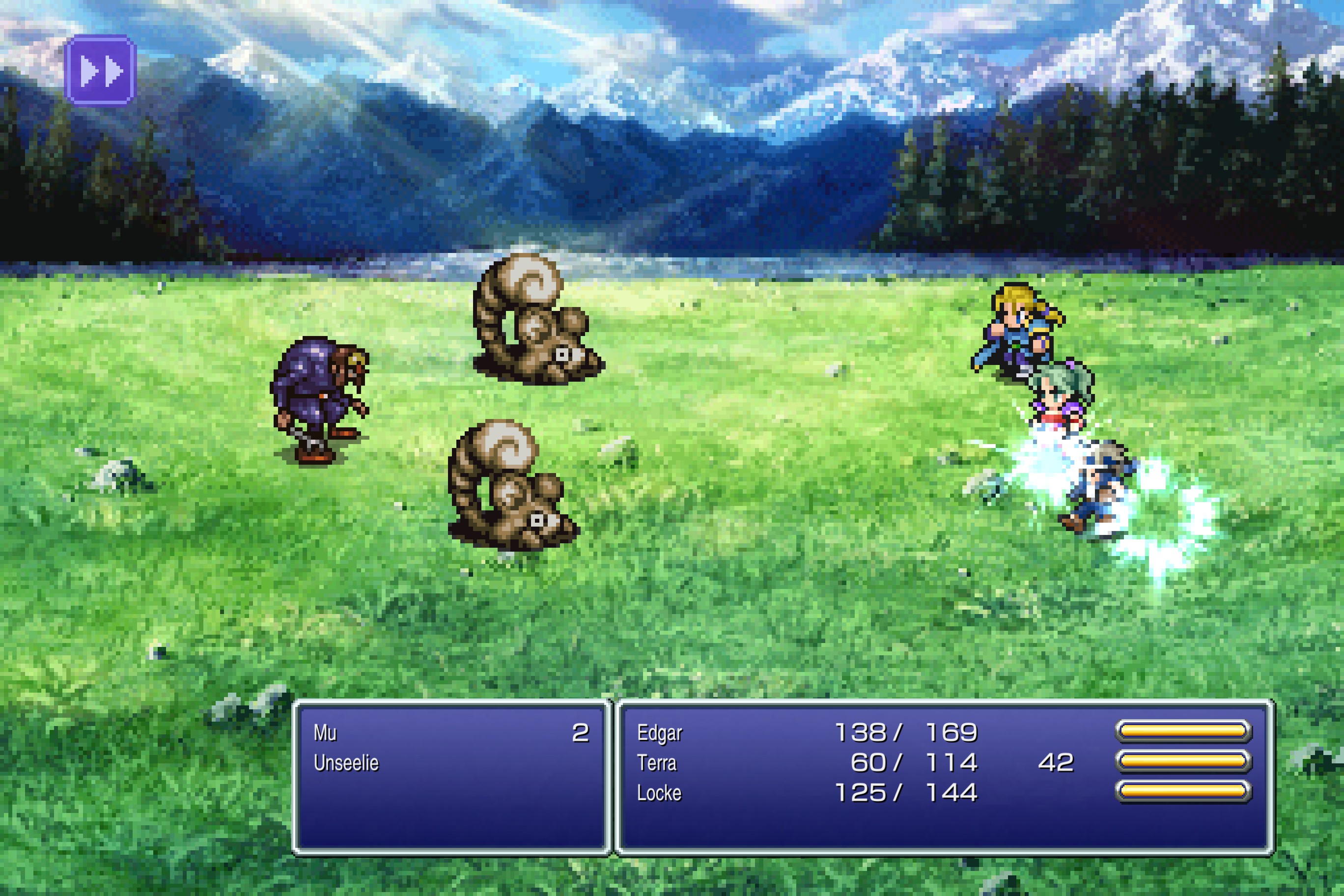
These are two pieces in a varied selection of music, but there are plenty of others with issues. As said before, some tracks are better, but I think it is safe to argue that the approach for most of the PR versions of these tracks and those for the five prior PR games is not in alignment with the approach for the original releases. Naturally, sticking too close to the original pieces won’t necessarily work in all instances. However, I can’t confidently say that the approach to updating the soundtrack led to an overall improvement for the games.
That all said, it could be a lot worse. The updated music still fits for the most part, and it does make for a decent listening experience. Also, there’s a menu option to use the original tracks if you’d prefer hearing them, which is a nice inclusion.
As a brief digression, the updated version of VI‘s chocobo theme contains a reference to Yellow Magic Orchestra’s “Technopolis”. The only reason I picked up on it was I’d heard the song for the first time a few weeks prior to my starting writing about the game. When I realised it made me wonder what references I’ve been unaware of due to not unfamiliarity with the referenced material. The “Technopolis” reference is neat, but awkward. However, with enough distance from the referenced material, it becomes just another thing in the game that can come off as awkward. Other references might just slide by without sticking out in any way.
I think it’s worth considering the nostalgia angle Square Enix went with for part of advertising series. It’s something that they seemed willing to apply to the games as they saw fit; the music being a prime example and VI‘s opera scenario being another.
The redone opera scenario is, arguably, against nostalgia. Clear (and admittedly fitting) vocals add a clarity to the scene whilst taking away the imagination the original version’s vocal abstraction allowed. Button prompts to progress some of it replacing direct control makes it more “cinematic” and “modern”. The changes probably speak to an idea of remembering how it was, but part of the opera scenario’s appeal was the abstraction and interactivity. Even though the outcome is binary, originally there still was a sense of agency. It worked because it felt like you were taking part and were more able to “hear” the words. Whilst the button prompts are fine and the scenario becomes more universally dramatic, there’s a detachment from the experience and it now feels more like spectating.
Further to that, I don’t understand is why Square Enix were willing to change the opera scenario, but not add characterisation in VI‘s second half as by that point most characters may as well not be there once their stories conclude. I imagine that, due to how the second half operates, time and space limitations made universal dialogue a necessity for the original version. Accounting for who is and is not present in a given scenario would have taken a while. Fair enough. Maybe Square Enix thought about adding and decided not to for whatever reason. Admittedly the opera scenario already has a firm base to work from. It’s an important scene too, for what they were doing as a developer, for the game’s plot, and for the fanbase.

Considering the benefit of additional space, however, not adding characterisation where it was needed seems like a missed opportunity. It especially seems so when a scenario was given changes that it didn’t need. Both are against nostalgia, but one offers an improvement to the game, whereas the other arguably doesn’t.
Across the six PR games there were some things that needed reconsideration, such as the large amount of empty space in battle scenes, odd character positioning and, both in and out of battles, text size. The map features are nice for finding treasure in the various areas, though they make it too easy to disengage. It also would’ve been nice to see auto-battling rethought in terms of how it operates, though doing so would run the risk of increasing tedium.
However, the eventual addition of adjustable modifiers for things such as EXP and encounter rate was a worthwhile change. They go against the design of the games, but giving the player more flexibility in how challenging these particular ones are for them is a good thing.
It’s nice that Square Enix were willing to update the first six mainline Final Fantasy games. Some are easier to recommend over others, but the effort remains appreciable. That said, the main reason why I recommend the Pixel Remaster versions is that they’re the easiest ones to access. They’re good enough remasters and they do come with some appreciable improvements. They also don’t promise anything than a core experience, but if there were more versions available (3D versions of III and IV aside), I don’t know how strong a recommendation I’d be offering.
But ultimately, if people like them, then does it matter how recommendable they are?
Final Fantasy VI feels different to the prior mainline FF games. At the same time, it’s resolutely familiar. You can see the foundations and building blocks, and how the development team used them to further their art. It’s the culmination of a lot of hard work and it paid off. It’s a game that means a lot to Square and the people drawn in by it. Whilst it has flaws, much like the prior mainline games, VI‘s strengths outweigh them. The game offers an expressive and affective an experience, and you still get that with the PR version.



 Stupidity Hole
these “remasters” are a laughable cash grab
LikeLike
I’ve been wondering as to what reasons have you thinking that they are.
LikeLike