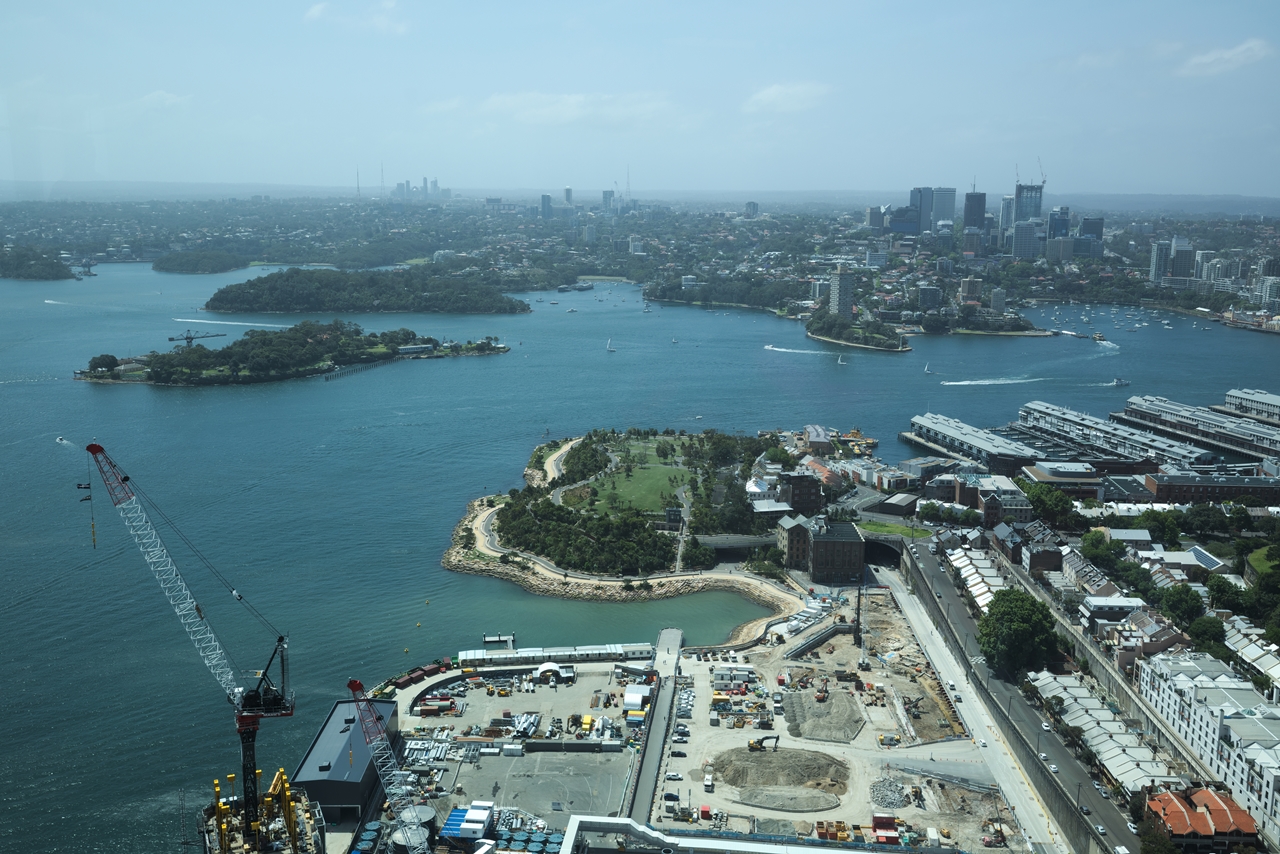
Above Barangaroo

Another photo from the same location as the last one.
This time providing a bit of a different view.

The view… a somewhat-aerial view of Barangaroo.

I like that a sense of progress in the Barangaroo area is strongly conveyed.
I think that the harbour helps to frame the two different sections of Sydney by making it easier to discern the environmental layout and differences.

I also like that you can see North Sydney, St Leonards and Chatswood in this shot. I think that being able to see them really enhances the sense of depth the closer to the horizon the landscape runs.

You can see a bit of sediment runoff around Barangaroo, which is something that I find interesting.

I hope you enjoy.

Posted in Photography | Tagged , , , , , , , , , , , , | Leave a comment

Haruki Murakami: Killing Commendatore Review

This Review can also be found on Culture Eater.
My colleague and I are working on growing Culture Eater, so please check it out and see what other people are contributing.

Anyway, here’s the review.

—–

Haruki Murakami’s Killing Commendatore is a novel.

The book opens on the protagonist attempting to capture the likeliness of someone without a face. After trying for a while, the protagonist admits that this is something he is having difficulty with. The commissioner states that they will return at another time before disappearing. This scene suggests significance but it never factors into the story. Well, outside of a follow up from something said off-hand, that is.

Perhaps opening scene was meant to function as a framing device, or give a sense of return to normality at the story’s conclusion. However, the scene is never revisited, serves no real purpose and feels like a leftover from an earlier version of the book.

Killing Commendatore‘s real introduction concerns the main character moving out form the city and eventually moving to the country with assistance from a friend. He separates from his wife. He then drives around a bit until, with the help of a friend, moves into his friend’s dad’s old place. Due to dementia, the father ends up in a retirement home and the old home needed a caretaker.

The father was a famous painter of Japanese paintings and the main character is also a painter. For the main character the situation is ideal.

Eventually the main character gets a commission to paint someone’s portrait. The main character had worked as a portrait painter. They had quit in order to paint their own paintings. This person specifically wanted the main character to paint their portrait. Despite initial hesitation, they take the commission.

It’s from here where the story actually kicks off. Kind of.

There’s a number of places in Killing Commendatore where the story begins. The protagonist getting commissioned by a mysterious commissioner is the easiest point to begin drawing a running thread.

Everything prior is more of a preamble. It’s not welcome nor unwelcome. That said, everything prior does occasionally have bearing on the plot and the main character’s thoughts and feelings. It’s more that it’s just kind of there than it is something significant.

Prior to this the main protagonist is having trouble painting. It probably serves as an allegory for Murakami when he came to approach this book.

Whilst following a main thread, Killing Commendatore also delves into the life of Tomohiko Amada (the prior-mentioned Japanese painting painter) as the protagonist (with assistance) tries to work out some of the reasons behind some of his actions through his life.

The majority of the narrative is passive and matter-of-fact. Things just kind of happen. The main character feels more like an observer than an actual participant in the events as he reports them flatly and seems to have little to no agency as a character. It’s as though he has no control at all and is merely an unwilling participant. How like life.

Generally the story flows pretty smoothly. However, too much of it comes off as sterile and flat. There’s a number of things that get that kind of focus that will imply something hidden that will later be revealed. Often these things don’t see a follow up.

There’s a point where the main character gets urged to take action. He is continually told that there isn’t much time. However, for all the rush it takes a while to happen. There’s meant to be a sense of urgency; that much is clear. It isn’t there though.

Earlier on the protagonist is hurrying at a pace that could suggest running. Whilst this is happening, he has the time to describe the pattern cast upon his body by moonlit branches. I understand that his having an eye for detail and a good memory would probably come into play here. Again, the sense of urgency isn’t there. The protagonist has the time to describe something that, given the situation, I imagine is something that they would not have been paying attention to.

At one point a character mentions a name that they should not know and then brushes it off with no real follow up. Aside from maybe a couple of lines it never comes up again and has no bearing on the outcome of the story.

Now this might all seem a bit nit picky, but these are things that compound on each other as the book goes on. Some threads are left dangling, and the ending is both sudden and ridiculously convenient. But then again, maybe this is all meant to be a reflection of things in real life. You don’t always get to find out what you want to find out. You don’t always get to see things come to a satisfying conclusion. Maybe.

To speak from a strictly personal view, I didn’t feel drawn in. Most of the time I was too aware that I was reading a book. There was one section where I was being drawn in. However, the dissolution of tension commenced once I remembered that what I was reading was a recount of events.

That all said, Haruki Murakami does write well. Despite boredom at times, I simultaneously felt engaged. Things do glide by pretty easily. The problem is that the book is not well-written. It has flaws. Some are significant.

The focus on breasts is particularly frustrating. There isn’t an issue with talking about breasts in a book, just like there isn’t an issue with talking about any part of the human anatomy in a book. However, it does become problematic when it comes up often enough to become uncomfortable.

When the protagonist is talking about his dead sister’s breasts and about how they were developing and wouldn’t develop further now seeing as she died, then that doesn’t make for something great to read. It could be metaphorical. It could be allegorical. When people have relatives die at a young age it can have a pretty serious impact on their lives. However, I don’t think that was what was being conveyed. I don’t think this as there’s a line trying to justify the observation. It comes off more as an afterthought rather than a justification.

I also have trouble believing that a young girl would have no issue discussing their lack of breasts with what is essentially a stranger. There are plenty of different people out there so it’s not entirely unbelievable. However, in combination with how the book was written I couldn’t believe that this and everything else I was reading could happen.

As an aside, I believe Murakami’s works see accurate translations. However, I can’t help but feel that some of Murakami’s intent and meaning may have been lost during the translation process. It makes me wonder how much of my criticisms are based on the translation and not the content.

A book called The 34 Mysteries of Haruki Murakami Killing Commendatore came out recently. I imagine that it helps to get a bit more in depth about a number of things in Killing Commendatore. Whether it’s official or not, I cannot say, but I still believe that it does help. However, unless you speak Japanese you’ll have to wait for a translation.

One thing I won’t fault Killing Commendatore for is the way the main plot and the exploration of Tomohiko Amada’s life come together. The narratives intertwine in an interesting way that I found satisfying. It was one of the few satisfying things in the book.

Obviously owning a book doesn’t mean you automatically understand its meaning and nuance. Not everything needs to have answers. The problem with Killing Commendatore is that it feels bloated and unfinished. At least one hundred pages could have been dropped without any loss. There is a logical progression to events and the main story makes enough sense. There are plenty of parts that suggest build up and go nowhere. At times there seems to be the implication of meaning without intent.

Killing Commendatore left me with questions, which is good. However, most of the ones I have involve asking about the writing and plot devices.

There is a good book in there; The writing is good, but it could have been better.

Posted in Reviews | Tagged , , , , , , , | 2 Comments

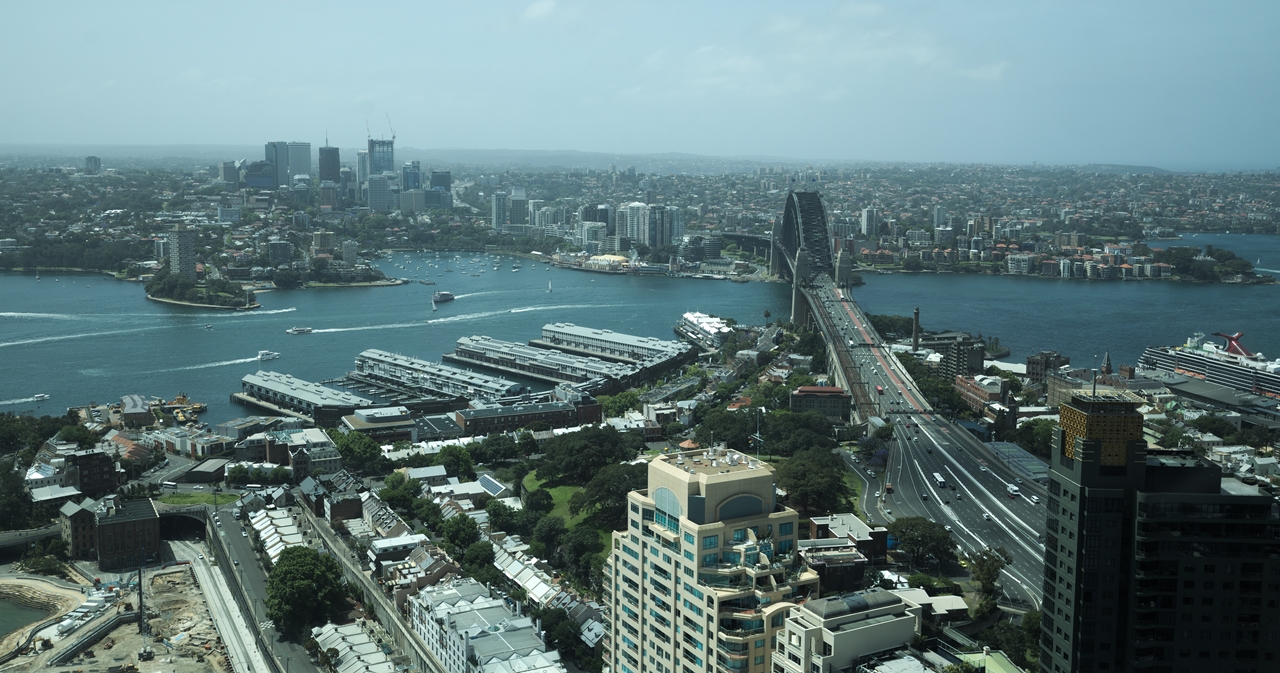
Sprawling Northward

A photo taken around the same time as this one.

I like this in part for it being an uncommon view of both The Sydney Harbour Bridge and North Sydney.

You get somewhat of an idea of the expanse and the layout of the area.

I also like that there’s a bit of traffic both on the water and the expressway, but the window that the photo was taken through makes the photo feel soft and relaxed.

I hope you enjoy.

Posted in Photography | Tagged , , , , , , , , , , | Leave a comment

Nearly Oratorio: Tin Review

Another review from Cool Try.

This one took a while to write and I’m not sure why.
I think in part it was procrastination.

I think is review is one of the better ones I wrote at the time, but I also think that it could be much, much better.

Oh well.

I’ve left grammatical errors in as I think that in this case it’s more important and honest for how I was writing.

I did fix a spelling mistake.

I hope you enjoy.

—–

Nearly Oratorio has released an E.P. called Tin.
Here’s a review of it.

The gentle piano sounds of “I Would Not” open Tin in a relaxing way.
Not long after, layered and warped-sounding vocals come in, floating somewhere around the piano, but never pushing it aside.

What follows is a collection of instruments and various sounds moulded into songs.

The songs are tender and relaxed, seemingly moving by in a slow, daydream-like state, driven by subdued, muted sounds that feel as though they were added together without any particular intent, yet not sounding awkward or out of place.

Despite the penultimate track, “Occlude”, a more energetic affair than the rest of the E.P., being followed by “Devonport”, a melancholic piano-driven closer, the tracks follow a logical progression and flow well.

The vocals seem to be more about the sound of them rather than the clarity.
That’s not to say that they cannot be understood; there are moments when they can. However, more often-than-not, they feel much more like a sound helping to add to the form of the music rather than their own distinct thing, making sounds that represent a vague idea of what words sound like rather than words themselves, leading to the music feel more instrumental than it is.

Tin is a quiet and relaxed E.P.
It’s not going to set the world on fire, but it’s worth giving at least a few listens.

Posted in Reviews | Tagged , , , , , , | 2 Comments

Downward

A view of part of the interior of an office building at Martin Place.

I like the geometry of the layout. I think tat it makes for interesting patterns, as well as a strong sense of depth.

I also like the way the light falls into this section of the building.

I hope you enjoy.

Posted in Photography | Tagged , , , , , , , , , | Leave a comment

One Thousand Word Challenge 28: Suburban Days 3

And out through the entrance he exited and into the sun, the dry heat and the burning concrete.

From outside the cool sarcophagus of a shopping centre he exited and into the world. The journey home would be tough. His eyes a little more awake but still bleary, and his feet unsteady on familiar ground.

Still, it was cheaper than a cab and who knows as to how long he would be waiting in the sun for one to arrive? It was a quiet day and there was little hope for a chariot to ferry him back to the safety of his residence. To the safety of his melting, sweating walls in the oven of a living room. To the safety of the four walls that made up his bedroom which handled the heat better than it should.

Warmer than earlier it had become. It was a dry sun and it was drying the world and embodiment of reality around him. His lips grew parched not long after his timely exit, but he had to push on through. The ground hot, scorching his steps, the rough and smooth being felt tenfold. This was not a pleasant walk, but it was a walk that needed to be done. It was a walk that needed to be completed. There was shopping to bring on home.

Not long had it been since our protagonist had been inside. Sure, he was not entirely functional in the nice cool air-conditioned building, but comparatively he had been gliding. This was something else. This was like grappling with a wild, chaotic beast that was amorphous as much as it was distinctly shaped. Still, even in trying times one must push on where they can and there was stuff that needed a fridge more than he.

And so he pushed on, along a street, up a hill, down the other side and into a section of brief shade. The sun hung in the air high on this morning, but this was a spot where, try as it might, it would not reach. The air was warm, but this was something that could at least be treasured, even if it was only for a maximum of a few minutes based on the pace of walking.

Still, the ground would not relent and its heat carried on through. Deeper and deeper uneven parts of path seemed to dig into his feet. Deeper and deeper, yet push on he still had to. Not enough sleep, too much drink, too dry and suddenly the world was something that was perceived in a fashion that could only be described as more real than real.

Soon that shade would end and once more the sun, with its nigh-inescapable heat would be bearing down once more on their being, on their very person and that would once more prove that the trial is yet to end, for no brief respite could truly lead to the task at hand disappearing.

There were cold items that desperately needed refrigeration that were holding up much better than the person transporting them. Why, oh why did a day like this have to be the day in which the shopping needed to be done?

Did it even need to be done on a day like this? It was hard to tell. There was a need to buy food; that much was true. There was also a need to eat and a need to distract from all the thoughts swirling around in their head. there was a need to get away and do other things that needed to be done. There was a need to eat, but junk food would not suffice in this situation. Something healthier would definitely help. Water would definitely help.

How many times had this trip been made on hot days? Plenty of times. However, it never had felt as hot as it did in this instance. To feel things so much more keenly was something that he had never experienced prior. Or may be he had, but had not been as aware at the time. It was hard to tell.

Moving his legs in order to move his feet forward was growing more arduous and painful with each step. An expected numbness was kicking in, but pain was still very much the strongest sensation and despite losing the sensation of touch in his feet and each object beginning to feel more like an impression rather than something distinct, the pain Was there. It refused to relent and the combination formed something that was truly unique. Well, it was unique entirely to him in that moment, for ti was one that had been experienced before.

It was not quite the sudden jolt that brings one into being present in a room or situation, but it was enough to keep one firmly rooted into being very aware of their situation and surroundings.

Their feet burned as their skin cried and they moved as quickly as they could. It was a long stretch ahead to Parramatta Road. It was a long walk, but the sooner the end was reached, the better that this would all be.

Pushing forward, feeling their body grow weak and dry, their very being being punished for even daring to go outside. Why did a day like this have to follow a night like no other? Even though it was a night like many before, but it still was its own thing.

Pushing ever forward and the lights were reached just as pedestrians were given the right to cross. More shade across the road.

There was little to worry about at this point and so he seemed to glide with a grace that had not been used in a long time.

Into home he almost flew. He put stuff away as quickly and efficiently as possible. Once the task was complete, in his fatigued state, he stumbled to his bedroom, sat on his bed, put on his shoes and slipped into a deep, heavy sleep.

The time it took to write one thousand words: 14:22:89

A continuation of this.
Part 1 is here.

I’ve been meaning to write this part for a while and, well, things got in the way. Kind of.

I don’t think it came out as much as I had hoped. I know that I had planned for the last paragraph to come out in a certain way, but coming as the third part… not sure if it works as well.

I guess at this point I should begin developing the Suburban Daysiverse into something far more complete.

I’m happy with the speed, but I think that I meandered a little too much.

Written at work.

Posted in Fiction | Tagged , , , , , , , , , , | 2 Comments

“Horizon” by Mu Boyan

Mu Boyan’s Horizon.

Deep meaning, etc. etc.

This sculpture worked well with the scene at hand.

The form and design were both interesting and the sculpture felt more harmonious with the surrounds rather than clashing.

I hope you enjoy.

Posted in Photography | Tagged , , , , , , , , | Leave a comment

City and Colour: If I Should go Before You

Another Cool Try review.

Not sure about how I feel this one.

I think I was finding how I write reviews, but I don’t feel that the review says enough.

Oh well.

I’ve made two edits for sharing here:

One involved spacing in the first paragraph.
The other was fixing a misspelled word.

I hope you enjoy.

—-

Dallas Green has managed to establish himself with two separate bands.
However, it is interesting that both Alexisonfire and City and Colour sound as though they’re worlds apart. Whilst Alexisonfire seem to be getting back into gear, If I Should Go Before You indicates that City and Colour are still chugging along.

Much of the album blends folk, country and rock together quite smoothly.
Everyone works together as a unit and there’s an element of playfulness in the tunes.
It sounds as like the band are enjoying playing with each other quite a lot, which goes a long way as the songs are more confidently played.

There’s an upbeat feel that runs through most of the tracks.
Despite what seems to be fairly serious subject matter (much of the lyrics seem to be giving an adult look at problems that can arise in relationships), much of the music sounds quite poppy which keeps the mood light.

With that being said, the opener, “Woman”, feels much darker than the rest of the album.
It’s quite brooding and terse, having a bleak atmosphere coming from effective use of reverb and ambient sounds.

It also happens to be the longest song on the album.

However, it doesn’t feel any longer than other songs on the album and manages to not feel out of place.

Dallas Green puts in a solid vocal performance.
There are times when he sounds quite cute.
This isn’t a bad thing.
He doesn’t sound out of place and never sounds overly-emotive.
This works in favour of the songs as if he had sung in a gruff manner, despite what some of the songs would suggest, it would have taken away from their strength.

If I Should Go Before You is a strong album.
The tracks are well-written and performed by a band that clearly work well together.
It’s hard to say if it is the best album from City and Colour, but it certainly is a fine addition to the name.

Posted in Reviews | Tagged , , , , , , , , , , | Leave a comment

Senyawa: Sujud Review

This Review can also be found on Culture Eater.
My colleague and I are working on growing Culture Eater, so please check it out and see what other people are contributing.

Anyway, here’s the review.

—–

Senyawa have been around for a while and spent most of their career in relative obscurity. I’m sure that in some circles they’re massive. I’m also sure that in others they are non-existent. Either way, Sujud, their latest album recently saw the light of day.

The album is once more an exploration of sound from Senyawa. Carrying naturalistic themes, the album is a meditative (and somewhat-less percussive than usual for them) record. Even in highly energetic moments Senyawa sound as though they have firmly embedded themselves within a spiritual state of focus.

A lot of this comes through in the use of both repetition and subtle progression throughout Sujud. It also comes through in the vocals, which often sound more like chanting than they do a measured vocal performance.

There’s also a strong sense of immediacy to Sujud. Several songs sound as though they were improvised on the spot. At the same time the songs don’t sound sloppy or loose. The songs could have been improvised or rehearsed; there’s enough to suggest either. Ultimately Sujud gains more character from the approach and the songs are more captivating for it.

Of note is how well auxiliary sounds fit into the songs. Toward the end of the first track, what sounds like scraped strings works as an implication of something unraveling. As the English title of the song is “Undo the World”, this is likely intentional and fits in well with both the theme and overall atmosphere of the song.

Of course this is not the only moment. There are plenty like this throughout the record, but it doesn’t become clear without repeat listens and consideration for what your hearing. In that regard Sujud is not an album that is willing to immediately reveal itself. It is one that rewards repeat listening, as cliché as that sounds.

All of this is to say that Sujud works well as an album. There’s a kind of dark sound, but the album doesn’t feel dark. There are some moments where it’s a bit more on the menacing side of things, but there’s a sense of calm and, as mentioned earlier, meditation through the whole record.

Once more Senyawa have shown that they know how to work well with what they have to create something so much more. Sujud is a deceptively deep, atmospheric and expansive album. The album sounds and feels deliberate and considered, yet still highly expressive. It makes for a rewarding listen and insert hyperbolic remark about Senyawa and Sujud here.

Senyawa’s Sujud can be found here.

Posted in Reviews | Tagged , , , , , , | Leave a comment

Top of the Tree Once More

This is almost the same photo as this one.

However, with a different camera and a better idea of how to process photos.

Also, a different angle for a different perspective.

I like the original, but I think I like this one more.

I think the colour balance is a bit better and this one looks and feels more real to me.

This is my submission into Leanne Cole‘s photo challenge.

This week’s theme is “Christmas”.

I suggest checking out Leanne’s photography, as well as checking out what other people submit into the challenge.

You can find the challenges here.

Anyway, I hope you enjoy.

Posted in Photography | Tagged , , , , , , , , , | Leave a comment