
Not a great photo by any means, but I like it. It’s not quite minimal, but it feels minimal. Also just very matter-of-fact.
I hope you enjoy.

Not a great photo by any means, but I like it. It’s not quite minimal, but it feels minimal. Also just very matter-of-fact.
I hope you enjoy.
So yesterday I did the thing I set out to do. Almost made it to ten, which was the original idea, but I got to nine, thought about doing this after, but then decided rest was more important. I’m not sure how I feel about the whole thing, or rather, I’m not sure of my certainty of it, if that makes sense, but I certainly don’t regret the effort I put in. I don’t regret the writing I did, and I don’t regret what I posted, or published, or whatever we’re referring to it as these days.
The stuff was more spaced out than I had initially hoped, and maybe that’s why I was able to succeed. However, in doing so, I spent a lot of time not doing other things, and it’s reinforced something that I’ll touch on in a few days. It’s possible I succeeded due to having energy to do so. That’s definitely a consideration I need to keep in mind.
I think the biggest issue I had is that I am still very drained in terms of creativity. I’m still struggling with trying to get a job and trying to survive and not be homeless, and that is taking up far more time than I would like. It’s creating conflict in a space where I need more harmony, but I’m still going and if I am still going, then I can still write and do all that I need to do. But soon there will be a break of sorts, and a shifting in priorities.
As I’m writing this now, I realise that I have a lot of ideas that I want to put forward, but they seem to go out the window when I try and then it’s more struggling. It’s more writing about nothing, and I still churn that out, and I have to wonder as to why I keep doing that. It can’t just be because I feel compelled to write. It can’t just be that. Maybe it’s habit. Habit can be good and habit can be bad, and in a way this is bad. I cover a number of different things here too; it’s not like I’m starved for variability, so I can always pivot if necessary, but I don’t do that often enough, I think.
There’s a lot of stuff to think about, and having done what I did yesterday; having put out nine things, I’m left thinking about the result and trying to confirm what I learned. It probably wasn’t worth it, but I can get behind it and that’s the main thing, really. On a personal level it was definitely worth it as I was able to clear some things, and that leaves me with some small comfort and happiness. But for now, I’m going to try and push out a bit more again. Try and keep going and see if I can keep up some momentum.
At least, for today, that is. Tomorrow I’ll go back to laziness.
The time it took to write five-hundred words: 06:48:65
Some stretching and reaching here, but I think this bit works, or rather, it shows potential.
Written at work.
Another rough draft, but this one is for the next thing that I’ll publish on From Somewhere out the Back. After getting dumped, the piece on “Neal and Jack and Me” seemed to gain a new context by shaping the two pieces that’ll come after it, with the below being one and another, also on a song, following soon after. Writing has been a struggle, and most of the time spent on this draft was getting to a point where I could put words down.
There’s potential in the below, and it’s time to start editing to help bring that forward.
I hope you enjoy.
—
“Gigantium” is a big song. Perhaps… gigantic, even. It’s got big riffs, big drums, big vocals, but more importantly, big emotions. Stuff in there about regret, loss, grief, pain… all the fun things. The song travels slowly, letting its sound sink in, and it is, in a way, very singular, and that’s probably the point.
“Gigantium starts with a drum roll and then moves into its slow, driving motion. It’s already expansive, seemingly constantly growing from a singular moment into an overwhelming wideness. Vocals call out, seemingly strained, seemingly full and strong. Words about wanting to escape from Brann Dailor, which leads to Troy Sanders responding in the chorus in a much calmer voice, almost concerned and worried, and trying to comfort and support. Providing warning.
In that section the song seems to slow a little, take some breathing space. After the first repeat and expanding upon, a solo that seems almost broken, almost like an alarm comes forward, and the vamp continues on.
“Gigantium” is standard Mastodon fare, but it’s also very much not. It’s heavy, overwhelming, intense, but it’s incredibly gentle, and it remains as such after the second main drum roll which leads to the second half of the song, or rather, the second part.
Here melody increases by a significant amount. It moves more toward comfort, perhaps, and Brann keeps singing. “My love, so strong”, and it just hurts. It hurts so much and so bad, and I want to cry when I hear it, because this is a release and acknowledgement. This feels much like an uplifting moment, and it’s all sorts of beautiful.
The second solo comes in and, at first it feels a bit random. It starts slow and then moves into a little bit of shredding, but in reflection it’s really fitting. Everything stays driving, simple, letting the emotions come forward and that solo just builds on and expands, and it all keeps going. When the solo ends, the strings that had joined earlier become apparent. They draw out the last of the mood as they shrink away, and it’s such a moment. The whole song is, really. It has heaviness; it has emotional weight, but it sounds like the band choosing to keep living and to keep on striving to support each other and the people they care about.
Recently I was dumped. Eight years, and I won’t go into it too much. There are problems on both sides, and I think they can be resolved. She doesn’t. It didn’t come at a good time. Never does, really. My job contract is coming to an end and I don’t have much longer to get another one. If I don’t have money coming in soon, I don’t have a place to live. It’s a tough time.
When I first heard “Gigantium” a few weeks ago, I switched it off after hearing a brief snippet. I felt a strong “This isn’t my thing” thing. Something got me to go back to it, listened. Thought it was okay. Listened again. Soon it was on repeat quite a bit. It touched something inside. There was something about it that was getting close to that long stare, where you feel gobsmacked, overwhelmed and you ache, but there’s something positive about it too. There’s something beautiful and comforting, in accepting the pain.
After getting dumped I figured it’d be the song. You know, the one that hits so hard when you’re going through shit. To me it seemed like the timing was apt. Spun it. Felt nothing. It’s just another song.
Now admittedly the why of what Mastodon explore on that song is different to the why of how I’m feeling at the moment, and maybe that’s the reason, but I know I should be feeling something from this song and I’m not. It’s not there. I still think highly of it, but I’m not getting anything from it, and I know I should. I could go back to “Finding You”, which was the song during my last getting dumped eleven years ago, but that doesn’t seem like a good idea.
I did try it though. Didn’t feel anything.
I’m not numb. I’m feeling all the hurt and grief. But I’m feeling nothing at the same time. Maybe it’s Lianne La Havas’ cover of “Weird Fishes”, which I’d argue is better than the original, as much as that might be cause for disagreement. I was sitting in Ewe’s bar room and played it for him, and that made me feel something, but that’s not “Gigantium”.
What I know about “Gigantium” is that I’m going to keep trying to see where it takes me, because even if I’m not feeling anything from it, there’s still something about it that draws me in, and maybe I don’t have to be getting something from it right now. Maybe that can happen later, if it does at all.
But it’s still a song that appeals to me, and even though it’s not about what I’m going through, it’s still nice to know it’s there. And, perhaps I know why.
The thing about “Gigantium” is it does feel quite sad, but by golly it feels uplifting too. It’s one of those big moments that pulls at the heart, and it feels celebratory of friendship. Of bonds, and maybe it is, and that’s why it’s so appealing.
In this whole upending of my life, and dealing with being dumped whilst looking for another job before my current contract runs out, lest I now end up homeless, I’ve had so much support from my friends, and I’m so lucky to have them in my life. Some of us have gone through periods of silence, and we’ve made up. We recognise the issues between us and we keep going. I’ve gotten lucky to have these people who have stuck by me. These people have had my back for a long time, and helped me through some tough stuff, and I’ve been able to keep on going when I’ve needed them.
So I’m not getting the feeling from “Gigantium” that I thought it would give me, and it makes me feel a little sad in other ways. But I hear it, and I think of my friends, and knowing that they’ve got my back makes me feel like it’s all going to be okay, or at least helps me keep going right now.
I don’t do this stuff often enough.
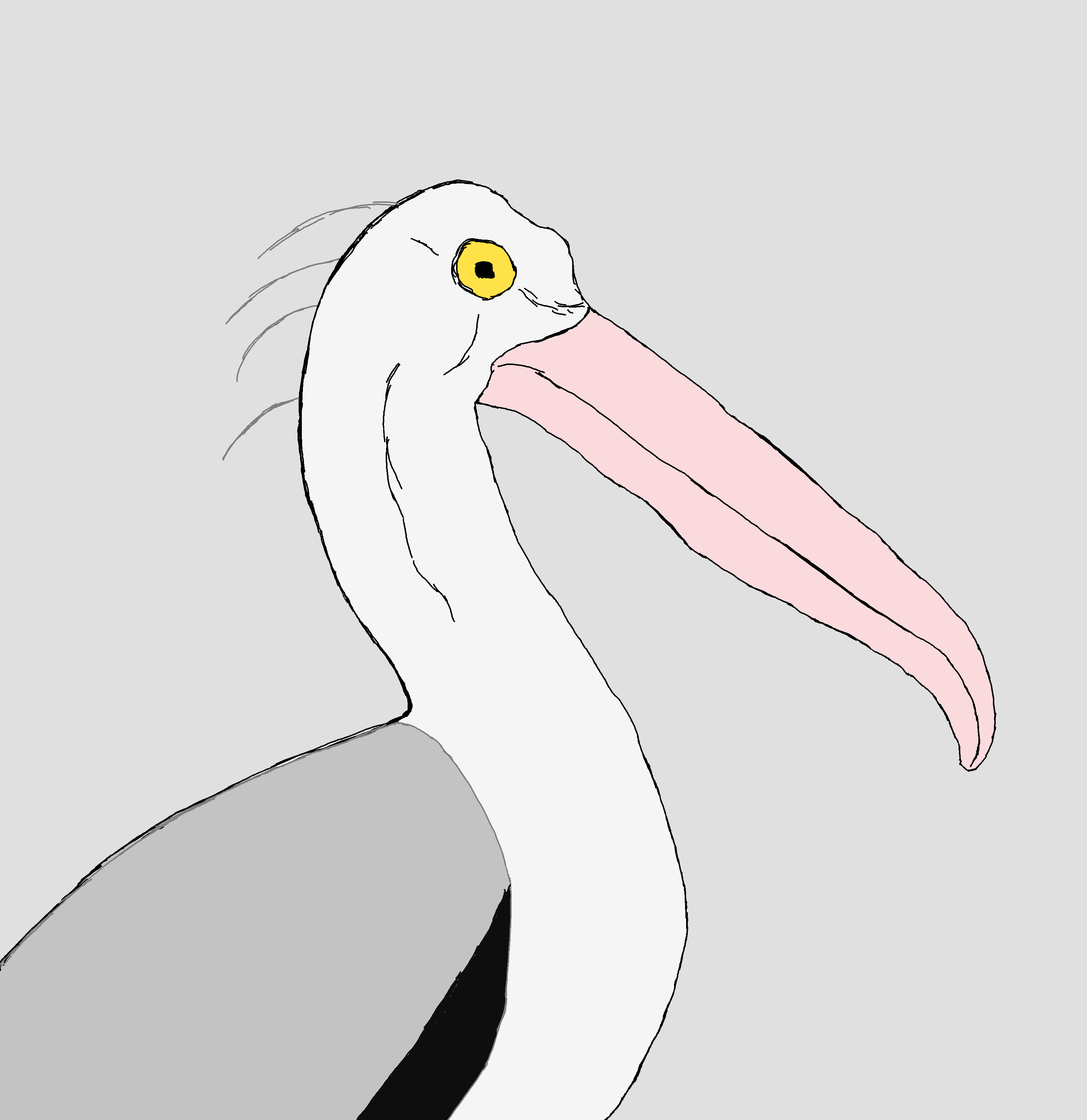
Anyway, recently the band Pelican shared a drawing of a pelican. I have a list of things I want to do in MS Paint, but something about that drawing made me want to do it, and so I did.
I tried to leave this a bit more loose. Did some cleaning, but I wanted to have an image that felt a bit more rough than what I’d usually allow myself to get away with.
This was started and finished today.
I hope you enjoy.
Here’s a rough draft of what will eventually be an essay/review on From Somewhere out the Back. I figured it’d be good to share the work now and then have the final version on the new writing space, because that’s where I’m wanting to put all my essay-type stuff.
The final version of this might end up being pretty different. This was written over the last forty minutes and I want to expand the focus on the fascination with The Internet, and how that ties into the game. I also want to flesh out some other things, so we’ll see what happens.
I hope you enjoy.
—
Way back when, if you were a kid or teenager when the Gameboy Advance came out, There was a good chance you at least heard of Mega Man Battle Network. For a number of people who played any, or enough of the Mega Man games in the nineties, this was more Mega Man but it was different. It was new, and more modern and sleek, and as futuristic as the early aughts themselves. Or at least, that’s how they felt.
A couple of years ago the two volumes of Mega Man Battle Network Legacy Collection were released. As the name suggests, they are two volumes of the mainline Battle Network games, collecting all six across… two volumes. Anyway, for a lot of people this was a moment to tap into nostalgia. It was a moment to go back and reminisce about things. I played the first three games as a kid, but I don’t have nostalgia for them. Occasionally I’d remember them and I’d think about playing them again, but mostly I was fine to let them be in the past.
Well, I ended up buying both volumes of the collection because I don’t know why. I had a vague memory of enjoying the first three and I guess at one particular moment I wanted to play them enough to buy them. They were probably also on special at the time.
I started with Mega Man Battle Network, as in the first of the series, and that’s the one I want to talk about in this space.
So Mega Man Battle Network (henceforth MMBN) came out on the Gameboy Advance. It was an RPG, and sort of a mix between action and strategy when it came to some of its RPG elements. It also contained elements of what is now referred to as deck-building elements, though it may have been referred to as having those in particular back then. I don’t know. What I do know, however, is it was a game that could only work because of when it came out.
One day Lan Hikari wakes up, running late for school, or soon to be late for school. Woken up by MegaMan.EXE, his Net Navigator (NetNavi for short) as always, Lan gets ready and rushes out to wherever the plot leads him.
Early on the game reveals the WWW, or World Three, a shadowy criminal organisation. I think they’re established before you take control, and I’m not too sure how to feel about it. MMBN does not feel like a finished game and announcing the main antagonistic force so early seems like a poor move. At the same time, it’s nice that it happens, because you’re not spending time guessing and then getting a potentially hackneyed development later on. WWW are the driving force of the game and its their machinations that you deal with throughout.
It probably helps that MMBN is not a subtle game. It doesn’t do much to try and make you guess about what is going on. There are builds, but there are few (if any) surprises. In a sense, the way the plot unfolds feels like a series of self-contained episodes in a cartoon, which is in part helped by the vibrant, kind of charming and catoony visuals, ripe for expressiveness yet unable to capitalise on them, and how they’re used to depict the world the game takes place in. It’s also helped by the music, which, whilst quite limited, still is highly expressive in terms of capturing mood, action, and the wonder of the new.
I’ll touch on that in a moment, but before I do I also wanted to mention that the plot goes by really fast, and feels like it drags in places at times too. The world of MMBN is fascinated with The Internet and what it offers, and the way that you interact with it is by connecting to ports to access it. This also is how you access dungeons. You control Lan in the world; you control MegaMan.EXE in dungeons and on The Internet. Because of how the plot plays out, and the limited design of a few areas, this can lead to numerous interrupts and a feeling of things dragging due to the repeated use of things. It’s…. fine, but it’s also not pleasant to deal with at the best of times.
As a side note, there are a lot of exclamation marks throughout the game. This is one excited game, to say the least.
MMBN‘s combat is interesting. It’s somewhere between action and strategy. Combat takes place on a three by six square grid, and usually you and the enemies have half each. You can move freely around the area you control, which can be increased and decreased depending on certain chips. Chips are where the deck-building comes into play, and help you deal with enemies. Various forms of damage dealing, area control and strategy come into play with them, though you can still attack enemies easily enough with your buster, though it will take longer than strategising. Every exty seconds you can open your folder and you’re given a random selection of chips (which will include ones you didn’t use last time you opened your folder). You go from there.
This is a really basic explanation, but it should get the idea across. You need to think about positioning, action, how attacks move, area control… there’s a number of things you need to think about. It’s complex stuff, but it’s easy to get into and understand how the stuff works. At the same time, what the game presents here feels much like a foundation to tweak and build upon, and subsequent games certainly did. Whilst there’s stuff going on, at the same time there’s not much, and battling can get tedious. Not helped is the inability to avoid battles entirely. You can escape from them from what I remember, so long as you make use of certain chips in your deck, but that’s not too helpful if the right chip doesn’t come up when you want it.
It compounds with the issues of how the game progresses, and whilst MMBN is actually brief, it feels like a slog. That also affects the depiction of The Internet, which is arguable needlessly complex in appearance, and also a slog to get through, but it’s part of why I like the game, as an idea.
When MMBN came out, The Internet was gaining large-scale traction. It wasn’t fast or “large”. A lot of us were there, in part due to places like GameFAQS and games like Diablo II. The traction provided by World of Warcraft and the promised convenience of smart phones was yet to happen. The Internet was a place that had some severe issues (though it still does), but it was new and amazing. It was this wonderful thing and it was full of potential and possibility. It was wide open, and that meant not understanding things and certainly wandering into the wrong space at times, followed by quickly getting out. It hadn’t narrowed in the way The Internet seems to have over time.
MMBN is fascinated with The Internet. There’s a good chance that the game revolving around it had to do with trying to maximise sales, but the team at Capcom that worked on this game believed in its potential, and they explored it. Whilst the depiction is needlessly complex in appearance and quite linear in execution, there’s a clear desire to make the most of it and explore it, even if the result, gameplay-wise, shows a lot of potential but doesn’t quite pay off. It doesn’t quite depict The Internet well, but the game certainly captures the experience, and how it felt to be using it in 2001. The future was in our hands, and we were experiencing it in the present time, and now we got to play a game that engaged with what proved to be more than a passing fad.
Sure, how it’s depicted here is limited in scope, and there are reasons for that. Capcom would go on to get a bit more fanciful (and fancifully bland) with how it depicted The Internet in the series, but here it’s at it’s most pure, potential-ready, and despite it not being as good as it could be, there’s something really earnest and genuine about it that I really respect. It’s not something that can easily be repeated. If somehow done with the same wonder today as it was then, MMBN would feel more like a throwback, or intentionally nostalgic game. Even if given all the improvements needed, it wouldn’t stand up as much as it does because it came out at just the right time for all the enthusiasm it has to shine.
Mega Man Battle Network is a flawed game in some glaring ways, but it gets a number of things right. Despite the drag and the sheer lack of polish, it’s highly charming. Characterisation is fairly simple, but it works because it’s over fast. The music is basic, but still carries complexity and fits use-wise incredibly well, especially for The Internet theme, which has that sort of futuristic, early aughts feel that seems organically digital. The other themes carry a good deal of emotional sway in them, though some do get grating. It’s a pretty game to look at, and it controls well too.
The game is simple, but it has big ideas. Flawed, but charming. Rough, but full of potential for something better, just like its fascination with The Internet.
One listen.
I wasn’t going to do any more music today, but I heard this song for the first time in a while and it sort of swept me up. I did struggle a bit, however, and I’m not sure I did well in conveying the song and what it conveys.
Go Ichinose’s (一之瀬剛) “Route 216 (Day)” (“216ばんどうろ(昼)”) is from Nintendo DS Pokémon Diamond & Pearl Super Music Collection, the soundtrack for Pokémon Diamond, Pearl and most of Platinum.
I hope you enjoy.
—
Bass pulses as keys twinkle around on a clear day. They twinkle and shimmer, and soon another sound drifts through. It drifts almost without a care. Percussion picks up and the sounds go into full swing. The bass keeps pulsing but everything here is lively. It’s lively, joyous, celebratory.
Some pull back, giving a bit of space and there’s still that relaxation. It’s all nice and easy, and there’s some pep in the step, but it’s all energised and taking it easy.
Soon the sounds pick up a little more and start going down a slope, almost, and keep looking at the fun and wonder of what’s around them. They then go over what they were looking at before, through the prettiness and ease, and they find it all fascinating, almost.
Adventure continues on through the layering of everything, and that pep remains as the sounds fade out and the song ends.
Well, I’m kind of halfway through what I set out to do today. That’s a good thing, maybe. I think I can get there. Still have a lot to do, but I can do this.
Okay, so there are reasons as to why I’m setting out to churn out words and posts at the moment. Or rather, there is a main reason as to why, and perhaps ancillary reasons that are also there, but not as much, and all that stuff… you know. But there is a main reason, or rather there is a reason that has come forward today that is pretty much the reason… but I can’t talk about it yet. But that’s the way things go.
Trying to write this with my wrist playing up. Not great. Not fun. I can get through it, however. I can get through worse than this. I am getting through far worse than this. This is something where I should be resting, but I’m being stubborn, in part, because it distracts me from the stuff going on in my life. Not much time left and all that.
I should be resting, but I’m tolerating the pain so I can distract myself some more. I’ll get to the end of the day and probably forget about all of this as my mind goes back to thinking about pain of the heart and all that, and that’s the way it goes sometimes.
Well, it’s the way it goes now, but it also sometimes goes that way.
I want to write something long, and I think I just might after this. I have something that I want to start drafting so I can publish it… assuming I get around to publishing it, of course. Writing this is easy, but writing stuff that I want to publish as essays, as critiques, is difficult. Everything is difficult at the moment. Surprising, I know.
I’m getting there, however. I’m getting through today. If I can get through today, I can see tomorrow and if I can see tomorrow, I can keep going. Just need to try and stay focused. Need to stay on task. Need to get more bits and pieces done today so that tomorrow comes with a little less stress.
I think what I’m doing here is trying to stretch for words, and right now that’s okay. I don’t have many thoughts going on in my head right now, or at least not many that are worth rambling about… maybe. Or rather, they’re just not presenting themselves as much as I’d have hoped. I also hope, however, that by the time it gets to a few days from now, I’ll be ready and prepared to tackle a long period of time, and maybe I’ll see some sort of success come forward from it. I don’t know, but there are exciting things coming, despite all the misery in my life at the moment. I just really hope that I get to see them all come forward.
The time it took to write five-hundred words: 06:47:23
Yeah it’s not great writing. I felt I had to, but this would’ve worked better not trying to write within a time constraint.
Written at home.
One listen.
I was expecting to describe the music as it was happening more than anything. I’m fairly certain I captured something about it quite well. At the least, I do like what I wrote.
Shota Kageyama’s (景山将太) “Unwavering Emotions” (“揺れぬ想い”) is from Nintendo DS Pokémon Black・White Super Music Collection, the soundtrack for Pokémon Black and White, and (to an extent) Pokémon Black 2 and White 2.
I hope you enjoy.
—
A firm conviction in one’s views comes forward, and what led to that drifts upon the keys and strings. Looking back at moments held firm, that marked changes in life and guided toward where one is now move past, but conviction can waver. Views can change.
Heartwarming, saddening, uplifting in moments that seem small, yet profound; all is carried forward to see where the path guides as the song ends.
One recent morning after parking and walking over to the building in which I work, I took this photo. It was a good chance to capture space and so… yeah. I probably could’ve cropped more of the top off, but I like this bit of light sitting at the top. Impacts the feel.
This is my submission into the three hundred-and-forty-fourth Lens-Artists Photo Challenge. The theme for this one is “Abandoned“.
This area is most definitely not abandoned, but in this particular moment it feels like it was abandoned quite recently.
The host of the Lens-Artists challenges cycles weekly between the following people:
This one is curated by Anne. The next one is curated by John.
I recommend joining the community and participating in the challenges. They’re pretty straightforward, allow room for interpretation, and provide a good way to think about photography in general. If not, however, then at the very least you should check out what others submit to the challenges.
I hope you enjoy.

One listen, though with a restart early on. The reason being was that I was thinking far, far too much about what to convey. Let go a little and the words came forward, and this became easier to write.
So before I go on, I have a heavy aversion to writing or covering anything about Pokémon. It has been covered far more and far better than I could ever want, and it’s not ground I care to go over. Generally I’m a fan more of the areas the franchise presents, as well as some of the music spread throughout, and that’s it. The Pokémon world is an absolutely fantastic one, and so very interesting to me, and it still has some great potential for exploration.
With that being said, right now I’m feeling like writing about some of the music the games use, so that’s what the below is. I teased out some of the mood that I felt was there and I think I did a good job of that. Not sure if I captured the song well enough overall.
Go Ichinose’s (一之瀬剛) “Pokémon League (Day)” (“ポケモンリーグ(昼)”) is from Nintendo DS Pokémon Diamond & Pearl Super Music Collection, the soundtrack for Pokémon Diamond, Pearl and most of Platinum.
I hope you enjoy.
—
Relaxed keys carry a subtle grandness to them. They ask to take it easy; to rest, perhaps due to the long journey to get to where they are. They fill a little, and keep it all low and relaxed, but some drama is rising.
The keys move lower and reflect upon what it took to reach this point, and there’s something fond within them. They carry that fondness, and that sentimentality into a further winding down.
A return to the start sees the keys asking the same things again, but at this point it does feel more relaxed. More calm. More time to take it easy, but there’s that drama. There’s that grandness and conviction, and there’s some joy in it all too. The reflection continues, and it’s what drives moving forward, into the keys fading away as the song ends.



 Stupidity Hole